'%3e%3cpath%20d='M31.96%2042.4211V31.2583H35.3337L35.8398%2026.9067H31.96V24.1288C31.96%2022.8693%2032.2738%2022.011%2033.9025%2022.011L35.9764%2022.01V18.1178C35.6177%2018.066%2034.3866%2017.9474%2032.9537%2017.9474C29.9616%2017.9474%2027.9132%2019.975%2027.9132%2023.6978V26.9067H24.5293V31.2583H27.9132V42.4211H31.96Z'%20fill='white'/%3e%3c/g%3e%3cdefs%3e%3cclipPath%20id='clip0_820_4965'%3e%3crect%20width='22.8941'%20height='24.4737'%20fill='white'%20transform='translate(19.6235%2017.9474)'/%3e%3c/clipPath%3e%3c/defs%3e%3c/svg%3e)
'%3e%3cpath%20d='M36.9363%2019.0706H25.6868C22.0255%2019.0706%2019.0469%2022.0424%2019.0469%2025.6954V36.9196C19.0469%2040.5724%2022.0255%2043.5442%2025.6868%2043.5442H36.9365C40.5976%2043.5442%2043.5762%2040.5724%2043.5762%2036.9196V25.6954C43.5762%2022.0424%2040.5976%2019.0706%2036.9363%2019.0706ZM31.3116%2037.9992C27.6132%2037.9992%2024.6045%2034.9973%2024.6045%2031.3074C24.6045%2027.6174%2027.6132%2024.6156%2031.3116%2024.6156C35.0099%2024.6156%2038.0186%2027.6174%2038.0186%2031.3074C38.0186%2034.9973%2035.0099%2037.9992%2031.3116%2037.9992ZM38.179%2026.1937C37.0861%2026.1937%2036.1972%2025.3068%2036.1972%2024.2163C36.1972%2023.1259%2037.0861%2022.2388%2038.179%2022.2388C39.272%2022.2388%2040.161%2023.1259%2040.161%2024.2163C40.161%2025.3067%2039.2719%2026.1937%2038.179%2026.1937Z'%20fill='white'/%3e%3cpath%20d='M37.8527%2023.9653C37.402%2023.9653%2037.0352%2024.3315%2037.0352%2024.7811C37.0352%2025.2308%2037.402%2025.5969%2037.8527%2025.5969C38.3036%2025.5969%2038.6704%2025.2311%2038.6704%2024.7811C38.6704%2024.3312%2038.3036%2023.9653%2037.8527%2023.9653Z'%20fill='white'/%3e%3cpath%20d='M27.2234%2031.3073C27.2234%2029.0581%2029.0575%2027.2284%2031.3116%2027.2284C33.5659%2027.2284%2035.3999%2029.0581%2035.3999%2031.3073C35.3999%2033.5564%2033.5659%2035.3863%2031.3116%2035.3863C29.0575%2035.3863%2027.2234%2033.5564%2027.2234%2031.3073Z'%20fill='white'/%3e%3c/g%3e%3cdefs%3e%3cclipPath%20id='clip0_820_4970'%3e%3crect%20width='24.5294'%20height='24.4737'%20fill='white'%20transform='translate(19.0469%2019.0706)'/%3e%3c/clipPath%3e%3c/defs%3e%3c/svg%3e)


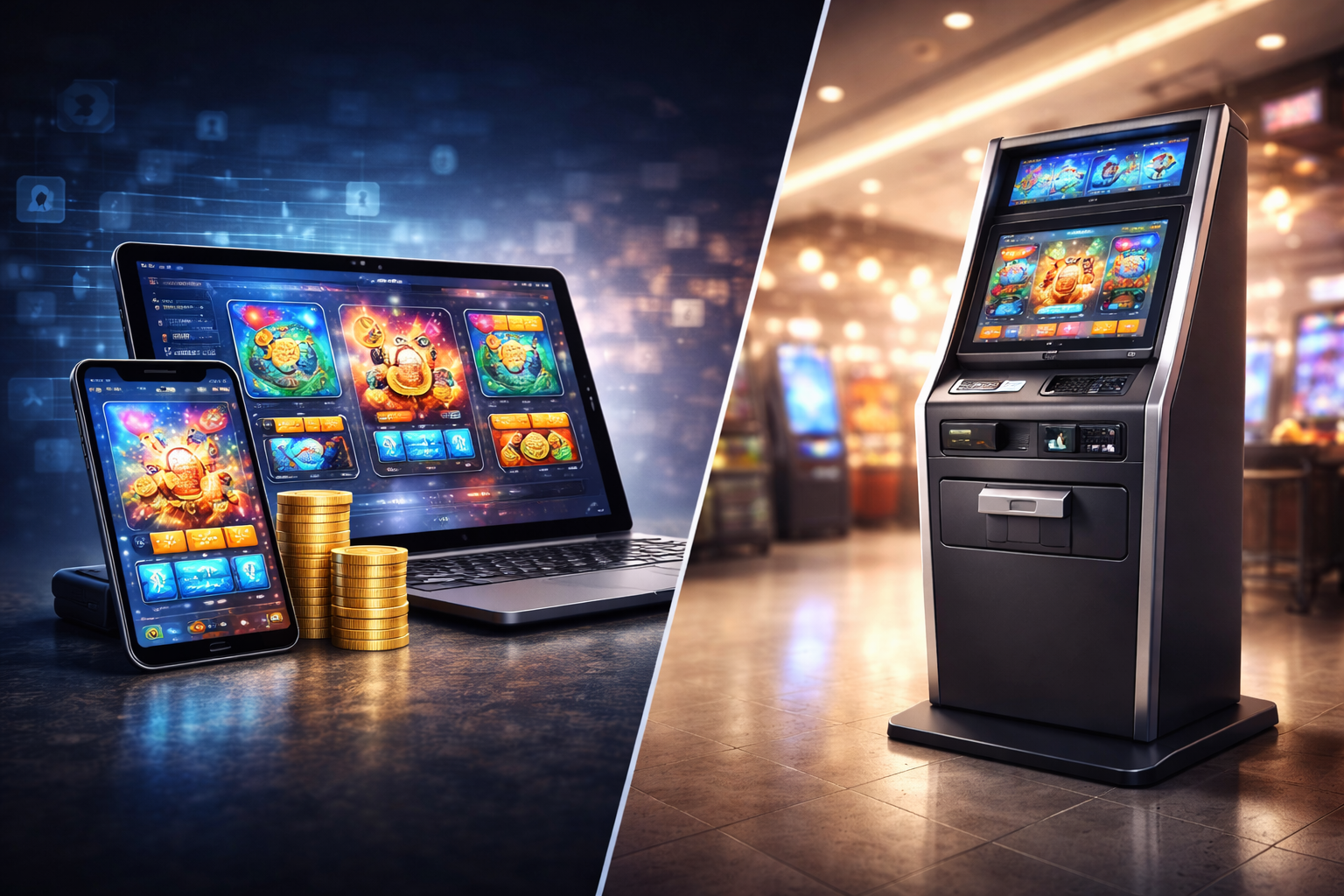
Online Gaming Systems vs Physical Kiosks: Choosing the Right Solution for Your Business
Owners of various companies are always searching for the right solutions for their businesses. In their search, they consider a variety of areas, including those related to the entertainment industry. This industry offers businesses a wide range of formats, enabling closer customer interaction. The most popular of these formats are physical kiosks and mobile gaming systems. While they differ in many ways, both can positively impact business performance. In most cases, this requires choosing the right option.

Overview of Online Gaming Systems
Businesses always need simple, accessible solutions that attract customers. Mobile gaming systems are one such solution. These specialized platforms enable remote interaction with large numbers of people, most often via mobile devices. This advantage minimizes the amount of equipment purchased and reduces start-up costs.
An equally important advantage of mobile gaming systems is their 24/7 operation. This allows for interaction with customers at any time of day or night. The only requirement is a stable internet connection. For businesses, such gaming systems are also attractive because they allow them to reach the widest possible audience. By providing access to the platform, company owners can grow their business not only in a specific state but also across the country or even internationally. Easily integrating with modern marketing tools completes the list of key features for play-at-home gaming systems.
Overview of Physical Kiosks
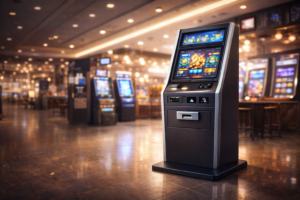
Physical kiosks are currently an alternative to mobile gaming systems. They remain effective and provide significant benefits to businesses. Physical kiosks are specialized hardware devices. They are placed in various locations (e.g., gaming establishments, shopping malls, hotels, and amusement parks) and almost always create a powerful visual impact thanks to their carefully designed exteriors.
The main advantage of using redemption kiosks for businesses is the high level of customer engagement they provide. Due to their presence in a busy location, these devices are always the center of attention. Physical kiosks also allow businesses to target their audience. By placing them in hotels, they can attract tourists and visitors from other cities/states, while in shopping malls and amusement parks, they can attract large numbers of residents. Equally important, self-service kiosks offer an opportunity to free themselves from the clutter of consumer devices. In this case, the business will not have to wait for a person to download an application or open the desired page in an internet browser.
Business Use Cases for Each Option
Mobile gaming systems and redemption kiosks are equally well-suited for businesses, though they serve different purposes. Each is better suited to address specific challenges faced by a company or brand.
Play-at-home gaming systems are ideal for promotional campaigns. Business owners most often use them for this purpose. By combining gameplay with the chance to win a valuable prize, they attract a large number of customers and achieve various objectives (e.g., collecting customer contacts, increasing product sales, promoting the brand). These systems are also used by businesses to implement international projects, increase the popularity of various bonus programs, and maintain customer interest in the company’s products and services.
Physical kiosks are used by businesses to achieve various offline goals. They can be used to promote a company or brand at an event with a large number of target audience members (for example, to increase awareness of musical instrument vendors at concerts, or sports equipment retailers during stadium competitions), to promote specific products or services, and much more. Redemption kiosks are also used by businesses whose income depends on spontaneous consumer actions (for example, buying decorative items, ordering food, etc.).
Operational Considerations
Mobile gaming systems are a good option for businesses seeking the simplest possible maintenance. They are significantly superior to physical kiosks in this regard, allowing for minimal staffing. Furthermore, all system maintenance is performed centrally, allowing for a small staff. The main challenge with play-at-home gaming systems is development and technical support.
From an operational perspective, self-service kiosks are a less cost-effective option for businesses. Their use requires the purchase and setup of expensive equipment, frequent maintenance, and replacement of individual parts or even the entire kiosk. Considering the complex logistics involved (equipment is often installed in locations far apart), maintaining physical kiosks is more time-consuming and expensive.
Which Option Fits Different Business Models
Every business has its own unique characteristics. These influence many aspects, including the choice between mobile game redemption kiosks and mobile gaming systems. Each integrates more easily into certain business models, so finding the best solution often requires considering a company’s operational nuances.
Play-at-home gaming systems are the optimal option for companies adopting a digital-first business model (e.g., banks, telecom operators). These companies focus on convenient digital solutions and therefore integrate mobile systems into their operations as easily as possible. At the same time, kiosks are the best solution for entertainment venues, stores, and shopping centers. Their physical presence in high-traffic areas opens up unlimited opportunities for businesses to implement any idea. For all other businesses, a hybrid solution, involving the simultaneous use of kiosks and mobile systems, is ideal. This approach achieves maximum audience reach.
For all business owners, choosing between physical kiosks and mobile gaming systems is a key consideration. To avoid mistakes in this process, it’s important to consider your company’s goals, customer base, budget, and many other factors. This approach will allow you to accurately evaluate the advantages and disadvantages of each option and find the optimal solution for your business.
Disclaimer
This text is for educational and entertainment purposes only and should not be construed as legal or business advice. This text should not be relied upon when developing a business plan or planning financial transactions and investments. The material presented is merely a legal overview and general information compiled by non-experts in specific fields. Before starting or managing this business, you should consult with a qualified lawyer, financial professional, accountant, and/or other professionals in related fields.